Views: 0 Author: Site Editor Publish Time: 2026-08-25 Origin: Site


A flip top training table is a commercial table designed for training rooms, meeting spaces, classrooms, and other environments that require quick reconfiguration. Its defining feature is a hinged tabletop that can rotate from a horizontal working position to a vertical position for easier movement, nesting, and storage. Many models also include casters, locking mechanisms, linking systems, and cable management.
Unlike a conventional fixed table, a flip top training table is designed around flexibility. The same room can be arranged for classroom-style training in the morning, collaborative work in the afternoon, and a presentation or open event later in the day.
For B2B buyers, this makes the flip top training table more than a piece of training-room furniture. It is a practical solution for maximizing the usability of commercial space.
The simplest way to understand a flip top training table is to look at how its tabletop moves.
The tabletop is attached to the frame through a pivoting or hinged mechanism. During normal use, the tabletop stays horizontal, providing a conventional work surface. When the table needs to be moved or stored, the mechanism allows the tabletop to flip upward into a vertical position.
Once the tabletop is vertical, the table takes up considerably less floor space. If the table is equipped with casters, it can then be rolled into a storage position or nested with other tables.
This combination distinguishes a flip top training table from many traditional folding tables.
A typical commercial configuration may include:
A hinged flip-top mechanism
Mobile casters, often with locking capability
A steel or aluminum frame
A durable commercial tabletop
A nesting design
Optional linking or ganging hardware
Cable management or power access
Optional modesty panels
The exact configuration varies by manufacturer and application.
A flip top training table generally operates through three basic stages.
The tabletop is horizontal and functions like a standard office or training table.
Users can work with laptops, notebooks, presentation materials, or other equipment. Depending on the model, the table may also provide integrated power, cable management, or data access.
When the room needs to be rearranged, the tabletop is released using its built-in mechanism and rotated upward.
The mechanism should allow the tabletop to move smoothly while keeping it secure in the required position. Commercial models may use different release mechanisms and locking systems, so buyers should evaluate both ease of operation and long-term durability.
With the tabletop vertical, the table can be rolled away on its casters.
Multiple tables can then be nested together, creating a compact storage configuration. This is one of the main reasons flip top tables are widely used in multipurpose spaces.
The entire process allows furniture to be moved without requiring staff to repeatedly lift or carry heavy tabletops.
The terms can sometimes be used interchangeably, but there is an important functional distinction.
A conventional training table may have a fixed tabletop with folding legs or another mechanism that allows it to be stored. A flip top training table instead uses a pivoting tabletop that rotates vertically while remaining attached to the table frame.
This creates several practical differences.
Feature | Flip Top Training Table | Conventional Training Table |
|---|---|---|
Tabletop | Pivots vertically | Usually remains horizontal |
Mobility | Often caster-based | Depends on model |
Nesting | Common | May be limited |
Storage footprint | Typically compact | Can require more space |
Room reconfiguration | Designed for frequent changes | Varies |
Linking options | Common on commercial models | Model dependent |
Best suited for | Flexible, multipurpose rooms | More stable layouts |
For facilities that frequently change room layouts, the flip-top design can provide a significant operational advantage.
Training rooms are rarely used for only one activity.
A corporate training room, for example, may need to support instructor-led training, team exercises, presentations, workshops, examinations, or informal collaboration.
A fixed furniture arrangement can make these transitions difficult.
A flip top training table allows the room to be changed much more quickly. Tables can be positioned individually for classroom training, grouped for collaborative work, or moved aside when an open floor area is required.
Current commercial products emphasize this exact use case. Vari's Flip Top Training Table, for example, is designed to be rolled, stored, nested, and linked with other tables for training environments.
For facility managers, the key benefit is therefore not simply storage. It is faster room transformation.
Although the name suggests training rooms, the application range is considerably broader.
Companies can use flip top training tables for employee onboarding, professional development, workshops, and internal training programs.
A conference room may occasionally need to function as a workshop or training space. Mobile tables make it easier to switch between configurations.
Educational environments often require flexible classroom layouts. Tables can be rearranged according to teaching methods, class sizes, and activities.
Event spaces frequently change configurations between sessions. Compact nesting storage is particularly useful when furniture needs to be moved between events.
As workspaces become more adaptable, furniture needs to support different activities rather than a single permanent layout.
Libraries, training centers, public institutions, and other facilities can benefit from furniture that can be stored efficiently between events.
Not every flip top training table is equally suitable for commercial use. Buyers should look beyond the basic flip mechanism.
The mechanism is one of the most important components.
A commercial table may be flipped and moved repeatedly over its service life, so the mechanism should be designed for frequent operation. Smooth movement, secure locking, and intuitive release are all important.
Mobility is fundamental to the concept.
Locking casters allow the table to move when required while remaining stable during use. The caster specification should also be appropriate for the project's flooring and expected load.
Some commercial models specifically combine roll-and-lock casters with nesting functionality.
Storage efficiency can have a major impact on the usability of a training room.
A good nesting design allows multiple tables to be stored closely together without requiring excessive floor space. However, buyers should compare the actual nested dimensions between models rather than assuming all flip top tables offer the same storage efficiency.
When several tables are used together, linking hardware can help create stable, consistent configurations.
Some commercial flip top training tables offer brackets or ganging clips that allow tables to be connected side by side or in other arrangements.
This can be particularly useful for larger training rooms and classroom-style setups.
Today's training rooms are technology-enabled environments.
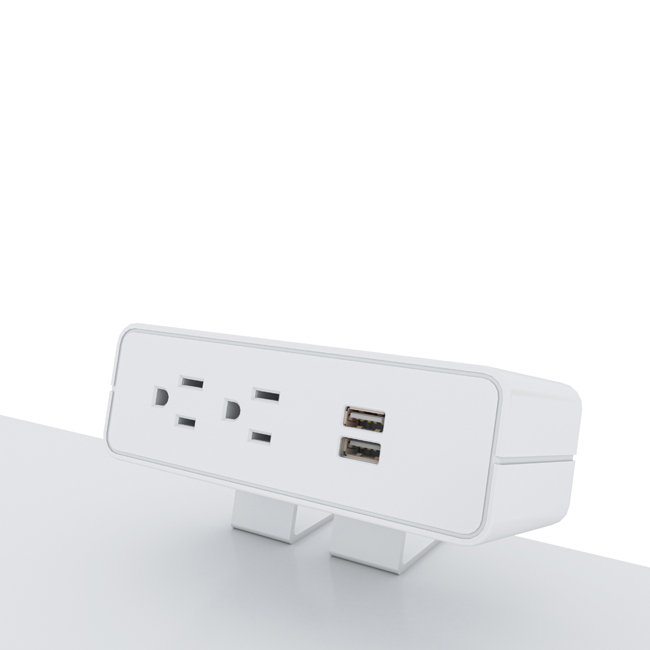
Laptops, displays, chargers, and other devices can quickly create cable clutter. For this reason, cable management, grommets, power modules, and data connectivity can be important considerations when specifying a table.
Some current flip top training table models include cable management openings or optional power solutions.
For B2B projects, it is worth considering power and cable management during the furniture specification stage rather than adding them later.
Training furniture can experience significantly more movement and handling than conventional office furniture.
The frame, tabletop, casters, joints, and flip mechanism should therefore be evaluated as a complete system.
For buyers sourcing furniture for offices, schools, hotels, or contract projects, durability should be considered alongside appearance and initial purchase price.
A flip top training table is particularly suitable when a space needs to perform multiple functions.
It is a strong option if:
The room layout changes frequently.
Tables need to be stored between sessions.
Floor space is limited.
One room serves several purposes.
Furniture needs to be moved by facility staff.
Tables need to be nested efficiently.
Multiple tables may need to be linked together.
Users require access to power or data.
On the other hand, a flip top mechanism may provide limited value in a room where tables remain in one permanent configuration.
The right furniture solution should therefore be determined by how the room is actually used, not simply by the table category.
So, what is a flip top training table?
It is a mobile, flexible commercial table with a hinged or pivoting tabletop that can move from a horizontal working position to a vertical storage position. Combined with casters and nesting capability, this design allows training rooms, meeting spaces, classrooms, and multipurpose environments to be reconfigured and stored more efficiently.
For B2B buyers, the most important consideration is not simply whether a table can flip. The real question is whether its mechanism, mobility, nesting efficiency, durability, linking capability, and technology integration match the demands of the project.
When specified correctly, a flip top training table can help organizations turn one fixed room into a genuinely flexible workspace—without requiring additional floor space for every new function.